

Movies and Sports Betting: The Rise of Participatory Entertainment in Japan
Explore how movies and sports betting are shaping participatory entertainment in Japan, from Oscar predictions and odds analysis to state-run betting culture.
Participatory Entertainment in Japan: Where Cinema Meets Prediction Culture
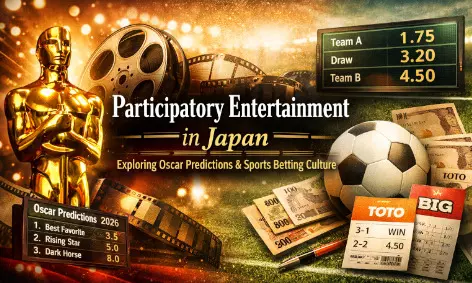
Movies and Sports Betting: The Rise of Participatory Entertainment in Japan
The way we enjoy movies has changed dramatically. Once limited to watching films in theaters and sharing opinions, the experience has evolved into one where audiences actively participate. This is especially true during the Academy Awards race, where prediction culture has matured. Specialized sites like AwardsDaily provide detailed analysis of predictions for Best Picture and acting awards, offering fans a platform for discussion. Audiences no longer merely watch passively; they engage directly in evaluations and predictions. The act of forecasting winners based on critic reviews and precursor awards has become central to the movie experience.
Social media fuels this shift. Fans share opinions in real-time on platforms like Twitter and Instagram. Communities form around hashtags like #Oscars and #AcademyAwards, discussing a film's strengths and weaknesses.
For example, at the 2025 Academy Awards, prediction events resembling fan polls became popular on social media. Podcasts also play a crucial role. Shows like The Oscar Podcast and Gold Derby invite experts to elaborate on detailed predictions. Listeners refine their own predictions while tuning in, gaining a sense of participation. These tools transform movies from mere consumption into collaboratively created entertainment. In Japan too, movie fan communities actively exchange Oscar predictions on social media. When viewers participate in predictions, the appeal of film deepens.
Common Ground Between Film Award Predictions and Sports Betting Culture
Film award predictions and sports betting share the pleasure of predicting outcomes. Both generate excitement through the tension of awaiting results. In sports, predicting the winner makes watching more immersive. In film, the process of predicting award winners is similar.
Take Japan's bookmakers as an example. While sports betting is strictly regulated in Japan, making private bookmakers illegal, public systems like toto and BIG exist. These involve predicting the outcomes of soccer or basketball matches, allowing participants to enjoy small stakes. For instance, toto, which predicts the outcomes of J-League matches, integrates prediction into the entertainment, moving beyond mere spectating. Participants analyze team data and player form to make predictions. This structure parallels the film awards race.
The focus here isn't gambling itself, but the culture of participatory prediction. In Japan, state-run betting has become established entertainment, often shared among family and friends. Its appeal lies in heightening the excitement of the game while minimizing risk. Similarly, movie fans gain deeper understanding through prediction. The common thread is that active viewer participation enhances the quality of entertainment.
Analyzing the Film Awards Race Through Odds Thinking
Analyzing the film awards race through odds thinking reveals the structure of sports betting. In bookmakers' Best Picture predictions, the winning probability of nominated films is quantified as odds. These odds are calculated based on data such as critical scores, audience reactions, director reputation, and past award-winning films. For example, Rotten Tomatoes ratings and Metacritic scores serve as indicators of a nominee's strength.
This approach relies on the accumulation of criticism, data, and precursor awards. Results from the Golden Globes and BAFTA Awards serve as precursors to the Oscars. Some fans use data analysis tools to examine past trends. Just as sports odds represent a team's win probability, film odds calculate expected value. If a film receives high praise from critics, its odds decrease (indicating a higher probability of winning), and prediction accuracy improves.
The commonality between sports and film is the concept of expected value. In sports betting, statistical data is used to measure risk. Film predictions similarly consider box office revenue and the director's past works. In Japan, this odds-based thinking has spread among film fans, fostering a culture of scientifically enjoying the awards race.
Why is quiet participation preferred in Japan?
Betting culture is restrained in the Japanese market. Public gambling dominates, with horse racing and toto firmly established as entertainment, while private betting is legally restricted. Using overseas bookmakers exists in a gray zone, with few users. This stems from preventing gambling addiction and societal caution.
The difference between public gambling and private prediction culture is clear. Public gambling channels profits into sports promotion, limiting its scope to entertainment. Private betting, however, strongly pursues profit and carries higher risks of fraud. Japanese people tend to prefer the stable participation offered by public gambling. This quiet participation format aligns well with movie fan culture. Fans share Oscar predictions on SNS, avoiding excessive competition and enjoying the discussion. Betting similarly emphasizes the joy of prediction. Japan's unique culture provides the foundation for the gentle evolution of participatory entertainment.
The Future of Participatory Entertainment
Film and sports will share next-generation fan experiences. VR technology and apps will enable real-time predictions. In film, streaming services will interactively broadcast award races. In sports, betting apps will make matches more compelling.
In the future, the value of participation will expand beyond just predicting outcomes. Community building will be key, increasing interaction among fans. In Japan, within the framework of public betting, movie prediction events could potentially merge. Entertainment will engage viewers and offer diverse forms of enjoyment.





